
Project 5, unreleased
Introduction
During my time on Project 5, my responsibilities touched every step of the level design process - concepting, design, blockout, testing, set-dressing, bug fixing, lighting, collisions, scripting, and more.
A full list of my responsibilities can be found here:
Project Details:
-
Action-adventure game
-
Based on a high-profile THQ Nordic IP
-
Developed within a proprietary engine
-
Features combat, traversal, and puzzles
-
Singleplayer and co-op
-
Top-down perspective
-
Team Size:
-
31 devs in total
-
5 Level Designers
-
My Responsibilities:
-
Designing individual gameplay scenarios and full levels, ensuring that puzzle, combat, or traversal situations naturally align with the overall design goals of each level
-
Maintaining clear and consistent level documentation to communicate design intentions and track development progress throughout production
-
Building simple 3D models to support the transition from blockout to dressing
-
Set-dressing and lighting multiple gameplay spaces, balancing readability with visual storytelling
-
Implementing in-game events within gameplay scenarios using a proprietary scripting language
-
Coordinating work between Level Designers to maintain a consistent pipeline and workflow
-
Providing support to the SCRUM Master for a proprietary tool development team when needed
-
Collaborating with Tools Programmers to support the development of the custom Level Editor through Research, User Stories, Feature Designs, and QA
-
Helping to organize company events to support team morale and cross-discipline collaboration
-
Building prototype levels for programmers to test gameplay elements in a controlled environment
-
Managing level merging within the version control framework, ensuring stability and consistency across collaborative development
-
Serving as a primary point of contact for producers regarding meetings, follow-ups, or reportings for the Level Design Team
-
Identifying and resolving bugs during level development, addressing general issues, gameplay feel, and performance
-
Working closely with producers to help define and streamline workflows
-
Researching and documenting internal process guidelines to support efficient, repeatable workflows
-
Organizing internal playtests to gather feedback and iterate on design decisions
design - Open World Design
Collaborating closely with Art and Game Design, I concepted and blocked out various puzzle, traversal, and combat situations, focussing on readability, player experience, navigation, and exploration:


This section of the level was designed as a semi-open world space, seamlessly blending exploration, player freedom, and guidance around the three core gameplay pillars of Project 5: puzzles, traversal, and combat.
For this part of the level, the two primary story locations and the various points of interest were designed separately from one another. My responsibility was to design the open world space that connected these elements into a cohesive experience.
Goals:
-
create an open environment that naturally guided players toward the two main locations
-
offer meaningful opportunities for exploration through smaller, secondary points of interest


The main references for this environment were concepts created by the outsourcing studio Krass Kollektiv.
All concepts created by them for Project 5 can be found on their website here.

design - Open World Navigation
Given the constraints of a top-down perspective, not all design principles translate seamlessly from third-person games, for example. To better understand what would work for our game, I was tasked with a small research-focused project.
To improve player navigation and spatial orientation within the semi-open world, I designed multiple points of interest, with a strong emphasis on environmental storytelling.


Leaning more into the references created by Krass Kollektiv, I also structured the open space into 2 main areas, split by a huge crack in the middle.
This crack is always visible when passing from one side to the other, so the player always knows when they are entering the other side.
Additionally, the two sides were visually differentiated to explore opposite ends of the reference spectrum.
The left side features a more natural aesthetic, while the right side is defined by a stronger presence of man-made architecture.


both images on the right side were designed and dressed by Evgenii Zaitsev, the Senior Level Designer
design - Open World Pacing
Pacing was designed around a layered distribution of content, with multiple events spread throughout the environment and discoverable through exploration. The main path provides consistent, curated challenges that support forward momentum, while higher-difficulty situations are positioned as optional side content.
This approach allows players to engage at their own pace, giving them the freedom to step away from or ignore more demanding challenges without disrupting overall progression.
.png)
design - Traversal Example
This is an example of optional content that can only be discovered through exploration. The idea was to make use of the fixed camera perspective and available gameplay abilities to create a simple yet cinematic experience, using verticality to highlight the vista.
While the core concept and blockout were designed, created, and implemented within the semi-open world level by me, the set dressing for this location was done by Evgenii Zaitsev, the Senior Level Designer.
Sadly, I cannot show any gameplay of it, just screenshots:


design - Whiteboxing
The level design workflow covered the full level design pipeline, including a stage referred to as whiteboxing.
During this phase, level designers created basic 3D assets, known as whitebox models, as an intermediate step between blockout and final set dressing.
These models were intentionally simple and highly iterative, representing only the rough shape and, more importantly, the volume of the intended assets.
Working closely with the Art Team and our Assistant Producer responsible for outsourcing, Maike Nagel, we created whitebox models for all requested assets.
The gallery here showcases various locations within a level at different stages of the whiteboxing process:


design - Polishing and Collisions
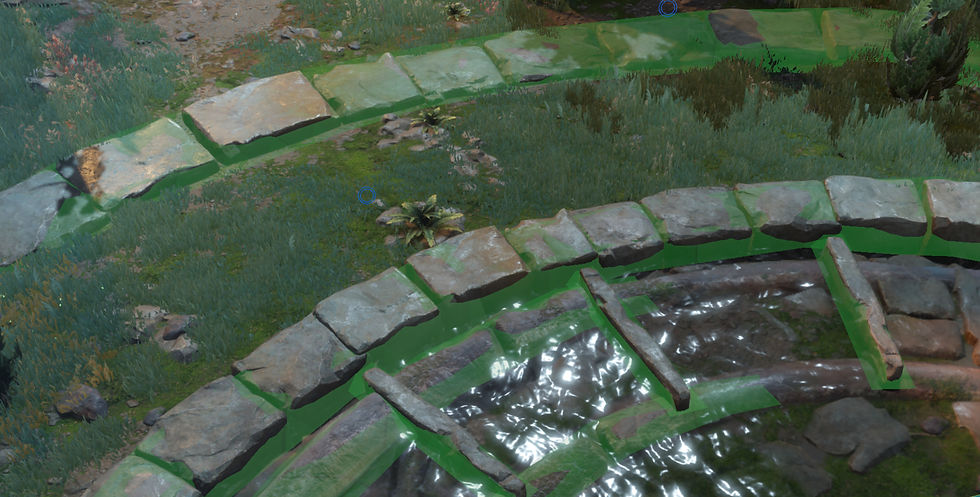
Fixing bugs, polishing the level, and manually adding custom collision where necessary were also key parts of the process.
The following examples show small collision adjustments I made to resolve minor edge cases where players could become stuck while moving through the environment:

art- Set-Dressing
Here are some examples of areas that I dressed:


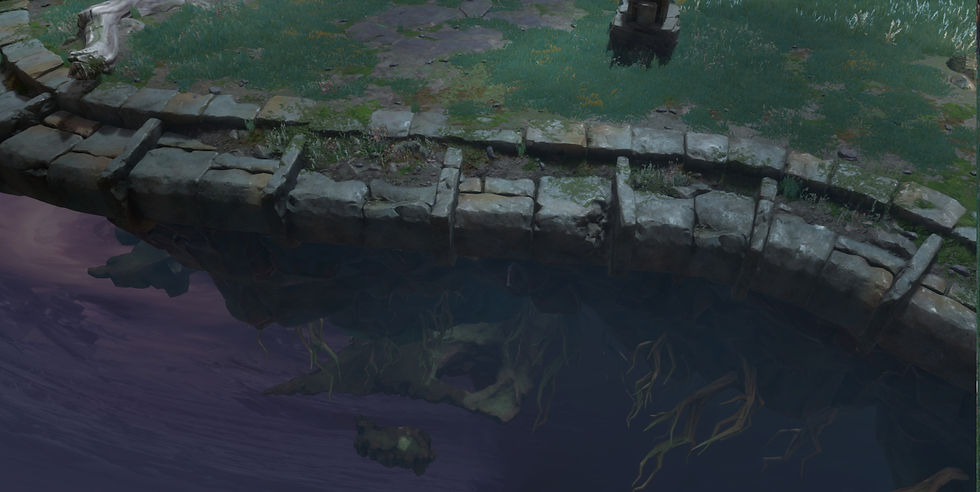
The following gifs showcase how several of the areas I dressed were developed. For these sections, my responsibilities included terrain sculpting and texturing, integration of game-ready assets, foliage placement, decals, background elements, environmental FX such as fog or dripping water, and lighting.
I also created background environments for the level, using specially designed background planes, background assets, fog planes, environmental FX, and lighting.

projects - Research and Documentation
During my work on Project 5, I also worked on multiple smaller research projects that supported the development of our level design workflow:
1. Puzzle Guide
For this project, I contributed to research on puzzle design with the goal of classifying puzzles within the game into defined categories and difficulty levels.
The primary motivation for this research was level pacing. When a level called for a “simple puzzle” or a slower moment in the experience, it was important to clearly define what that meant in practice. This work covered puzzle difficulty, design approaches, planning considerations, and related factors.
Researching the topic and writing large portions of the documentation was challenging at every stage, ensuring clarity and shared understanding, refining definitions, and identifying what information was truly needed for the team.
2. Open World Traversal
My task was to explore how to guide players through an open world environment while ensuring that only movement itself remained fun, using solely the most fundamental elements of the environment and testing ideas as cost-effectively as possible, all while keeping the experience intuitive and avoiding anything that felt overly gamified.
To achieve strong results within the constraints of a top-down camera, I relied on height variation, shadow placement, vegetation, points of interest, vistas, and landscape shape to make traversal through an almost empty environment enjoyable and natural.


development- Proprietary Engine
At KAIKO, I was working with a proprietary engine developed specifically for Project 5.
Using the custom-built Level Editor, I created levels and designed gameplay situations tailored to the needs of the project. In parallel, I collaborated closely with Programmers and assisted the SCRUM Master in the ongoing development of the Level Editor itself - contributing to the expansion of its existing features, the creation of new ones, and overall improvements to its usability.

Spanning the entire range of development, the test levels created in collaboration with game design, programmers, or artists varied a lot. Basic gameplay, specific features, foliage, slope movement, combat encounters, FX, scripts, and more.
The scene above was a very basic test level created in collaboration with Game Design and programmers to test movement, jumping, and respawning.
Iterating based on design specifics, and needs and feedback from those I collaborated with, each test situation was individually crafted to support the development of the feature as much as possible.