
Cairo's Divide - Battlefield 6
WORK IN PROGRESS
this page will be updated again soon
Introduction
In this project, I created a Battlefield 6 level set on the borders of Cairo's rich neighborhoods.
(this project was created for fun and personal growth, and is not associated with the game itself or the Battlefield Studios / DICE)
Project Details
-
Battlefield Portal Editor
-
Godot Engine
-
~70h hours so far (2026)
-
Level Design
-
Blockout
Level Details
-
Gamemode: Conquest Small
-
32 players
-
2 Quadbikes and 2 Tanks per Team
-
3 objectives
DESIGN
design - Vision
At the beginning of development, I outlined one core vision for my level, heavily inspired by Johnny Miller’s Unequal Scenes:
Experience the inequality of real life through the environment and gameplay within Cairo's rich and poor neighborhoods.
The battle throughout Cairo has reached all classes of society. With the battlefield split into two distinct areas by a massive wall, NATO and Pax are fighting for control over key strategic areas with armored ground vehicles.


design - Layout
With the map being split into 2 parts by a wall, the goal was to make each area and objective play and feel unique. The objectives are layed out in a frontline between the two team spawns.
Because of this, the Team HQ's are also valid spawnpoints later on in the match, still useful to reach any objective quickly.
The layout also incorporates the wall into the map, and the actual level and gameplay more, as the objectives are placed alongside it.
The two map halves are designed to support different playstyles and loadouts. The open, rich neighborhood up top acts as a contrast to the more CQB-focussed, poor neighborhood below.
.png)
.png)
.png)
Time to Flags
To make sure the map is balanced, each team takes roughly the same amount of time to reach each objective.
Although the objectives might be more easily accessible for soldiers on foot from the bottom spawn, the roads are layed out so that players from the spawn up top can reach objectives more quickly with their vehicles.
The times measured here are on foot from the center of the team HQ's in seconds.
a bit more info about this can be found at design - Team HQ's
Player experience / fantasy
Experience the inequality of real life in gameplay and environment.
The upper part of the map (rich neighborhood) is more open. Wide streets, open spaces, and long-range encounters are great for Snipers. Here, big statements in architecture, an overall clean look, lots of colors in the environment, and more freedom to choose your path allow for more calm, grounded combat. Supports can help their team with smokes or lay down fire with their LMG on enemies. Vehicles thrive here, allowing them to engage openly in combat with less fear of being ambushed in the open.
The lower part of the map (poor neighborhood) is focused on CQB combat. Tight corners and constricting gameplay spaces allow for messy combat with tight alleyways and verticality, fostering chaos.
Assaults and Engineers thrive here; ambush vehicles with your RPG or use your ladder to climb roofs. Creative use of your abilities results in gameplay advantages and wild combat situations.
Combat distances
To better design the overall size and distinct areas of the map, I also planned for a variety of combat ranges that I would want the player to encounter.
Short Range: 0 - 20/25 meters | Medium Range: 20 - 40/45 meters | Long Range: >40 meters
These distances allowed me to better plan for combat encounters.
Sightlines
Although each part of the map is focused on either longer-range or shorter-range combat, both sides still provide opportunities for the other style to thrive in gameplay.
In the poor neighborhood of the level, the streets are a bit more open on purpose, so that the player will need to take extra care when crossing them. Inspired by scenes from The American Sniper Movie, the player is supposed to feel vulnerable when crossing the streets.
Within the rich neighborhood, the central locations within the area are built to support CQB gameplay. Especially the construction site at objective C provides chances for players to fight their enemy up close.
.png)
design - Navigation and Orientation


Vehicle Paths and Street Layout
With each team having two quad bikes and two tanks, vehicles play a crucial role in attacking and defending the objectives.
To accurately display the streets of Cairo, I spent some time analysing the street layout through Google Maps and Street View.
The flow of streets in rich and poor neighborhoods is quite different:
Rich Neighborhood:
-
Lots of space
-
Plants in between houses and roads
-
Often rounded streets and roundabouts, has flow


Vehicle Chokepoints
Vehicles can only cross into the other area using certain chokepoints. These offer great opportunities for infantry to ambush an enemy tank or strategic objective gameplay.
If one team locks down one of the vehicle paths, it becomes harder for the enemy team to support their troops as they need to find another way for their tank to reach the frontlines.
.png)


Poor Neighborhood:
-
Generally roughly follow some form of grid
-
Many buildings cramped in-between roads
-
Tight Space, Hard Corners
POI's
To improve orientation throughout the level, there are also certain POI's to help the player. For example:
-
The Wall splitting the map into rich vs. poor
-
The Crane in the construction site on objective C
-
The environment itself (rich vs. poor)
Additionally, each area is distinct and recogniseable, built to play and feel unique. The market, the residential space, the checkpoint, the construction site, ...


design - Objectives
Objective A - Market
-
Keywords: tight, ambush, chaos, verticality
-
Infantry Combat only
-
Limited natural entrances through chokepoints
The objective itself is encapsulated by buildings, allowing only infantry to enter. The capture area for the objective is only on the bottom floor.
Fighting enemies in short to mid-range combat, the fast-paced situations will create messy and chaotic situations.
The shelves and boxes in the middle of the objective provide cover for quick ambushes and surprises, but can be destroyed, leading to a change in environment and gameplay as the match progresses. When many parts of the middle are destroyed, the space becomes a no man's land, forcing players to adapt to new situations and use their utilities, like smoke grenades or the GPDIS (Grenade Intercept System), creatively to gain an advantage in combat.
Because the capture area is only on the bottom, players can choose how to approach the objective in more creative ways.
Going directly into the objective area (green arrows) will provide the quickest route into the capture area, but the player will have to push through certain chokepoints that will make their movement more predictable.
Entering through the top floor (red arrows), where the objective cannot be captured, will take more time and leave them slightly more exposed against others on the open top floor, but provide the high ground against enemies inside the objective, making it easier to clear them out first before entering.
The pillars on the outside create more cover for players inside the objective area, but will leave them more vulnerable to AoE damage like grenades that can easily flush them out.
.png)


Objective B - Checkpoint
-
Keywords: funnel, chokepoint, constricting
-
Infantry and Vehicle Combat
-
For vehicles only entry through chokepoints
The objective itself is a checkpoint from the poor into the rich neighborhood. Vehicles can enter the objective but have limited movement and cover options.
.png)
Holes in the wall (green arrows) provide options for infantry to push the objective from other angles than the two main entrances, offering more cover but also less security as it becomes harder to scan the battlefield for enemies before entering.
Although the main gameplay on the objective is short to medium range focused, the open entries from both sides present opportunities for vehicles or teammates to support their team from a distance as well.
Using gadgets can also help greatly to support your team by providing new ways to approach the objective or surprise your enemies.
Climbing the wall with your ladder, for example, allows the player to have the high ground in this objective. Though they are quite exposed up there, a brief advantage in combat can turn the tide in any fight.


Objective C - Construction Site
-
Keywords: open, bigger architecture statements
-
Infantry and Vehicle Combat
-
Entry from all directions
Objective C is a construction site, where a new housing block is being built inside the rich neighborhood.
Soldiers can enter from everywhere, but have the most cover when approaching from the direction of the team spawns. The landscape outside also provides opportunities for vehicles or infantry to support their team by firing from a distance into the objective.
.png)
Allowing attacks from all sides for infantry, the players inside the objective need to set up their defense accordingly. While vehicles can only enter the capture area from certain directions, the space inside offers more opportunities for movement, allowing the tanks to help their team effectively by positioning themselves correctly.
With no man's land in the middle, the buildings on the outside provide the most cover and potential for close-quarters combat inside the objective.
Gadgets, especially smoke grenades, are a player's best friend here. Crossing the open space in the middle can be very dangerous, so to minimise their chances of getting sniped, the player needs to get creative.


design - Team HQ's
.png)
Team 1 Spawn
Located inside a finished housing block in the top half of the map, the spawn has two main exits for vehicles and many small paths for infantry.
Team 1 needs a bit more time than Team 2 to reach the objectives on foot because the street layout allows Team 1 to reach the objectives quicker by vehicle than Team 2.
.png)
Team 2 Spawn
Located within the streets of the poor neighborhood, Team 2's spawn also has two main exits for vehicles, while infantry can take routes in between the buildings.
ART
art - Environment
Madinaty City - Cairo
The rich part of the map, especially its street layout, is inspired by a real city near Cairo, Madinaty.
The idea for the environment in the rich area is to have the housing blocks along a street with a golf course behind them, creating a large open space ideal for vehicles.


ITERATIONS
iterations - Process
At the start of development, I originally started gathering ideas for different settings I found interesting, these were the main 3 that stuck with me:
1. Offshore Oil Rig
The map here would consist of 2 big oil rigs in the sea with a big oil tanker swimming besides them.
The gameplay would here be focussed around air and sea combat, allowing the players to fly helicopers and drive boats.
The objectives here would be spread throughout the oil rigs and the boat.
Each Team HQ would be in an aircraft carrier.
2. Windfarm
Set in a windfarm in a mountainside, this map would use wind turbines as POIs and gameplay elements.
Although land vehicles would be present, the focus would be on air vehicles that would have the extra challenge of navigating through the spinning wind turbines while fighting each other and ground forces.
3. Rich vs. Poor
The idea that I chose in the end, was an interesting setting as a big separation in the middle of the space would allow for interesting and varying gameplay on each side of the wall.
The difference between rich and poor areas is noticeable throughout the environment and gameplay.
I still think that all of these ideas have potential and I would love to see them in a Battlefield game at some point.


There were a few things that I considered when thinking of and choosing ideas:
-
Singleplayer / Story mode potential. As Battlefield maps, that launch with the game, are often also featured in the singleplayer campaign, I wanted to choose a location that could also be used in a story mission there.
-
As the game was not released yet and it was not yet known what Battlefield Portal was capable of, I ended up choosing a location based on Cairo as it was already represented in game and I figured that those assets would most likely be available for use.
-
Relevance of the location to modern conflicts. Rich vs. Poor and the inequality through capitalism stuck with me as it is a topic driving lots of modern conflicts.
iterations - References
After deciding on a setting I wanted to use in my map, I started gathering references that portrayed the feeling I wanted to capture.


iterations - Roughout


After finding the idea I wanted to create, I started by blocking out layout ideas in the Unreal Engine as BF6 had not released yet.
When Battlefield 6 launched, I was then able to get a better reference for scale, now being able to measure stuff in Godot.
Metrics like street width, overall map size, or combat distances were important to figure out before starting to go into more detailed blockouting.
iterations - First Versions
I didn't hesitate and jumped straight into Godot with no prior knowledge about it as soon as Battlefield 6 launched.
This first iteration took the longest as I first needed to get used to Godot, Battlefield's map design, and the feeling of the map.
As this was the first version, there were obviously some issues, that I tackled when working on the next iteration.


Here are some examples of issues I fixed:

Objective A - Sightline into Spawn
When testing the level, I noticed that players were able to look into Team 1's spawn when standing in certain locations around objective A or on top of the wall.
I think the problems this created are quite obvious ...

Objective B - Perfect Camping Spot
In this first iteration of objective B, there was a destroyed bus in the corner of the checkpoint that could be used as the perfect camp spot for players.
It couldn't be destroyed by tanks and was pretty easily defendable.
As this was too strong and didn't align with my idea for this objective, it had to be cut.

Objective C - Objective Design
Objective C was designed as a more open "bowl flag" that was attackable from all sides.
Feedback noted, however, that this original idea was not working. No indestructible buildings and almost no cover from some sides created bad flow that made this objective a nightmare to defend.
iterations - Problems
These were the two biggest problems that slowed the entire development down for me and caused the most amount of problems:

Hard Building Limit
Although I understand why limits are there, the limit of around 30-40 destructible buildings is very low for a game like Battlefield, where almost everything can be destroyed to some degree.
In this image, you can see the amount of buildings I can use within a map inside a level that had the originally planned scale for my level, forcing me to scope down a lot.

No Terrain Editing
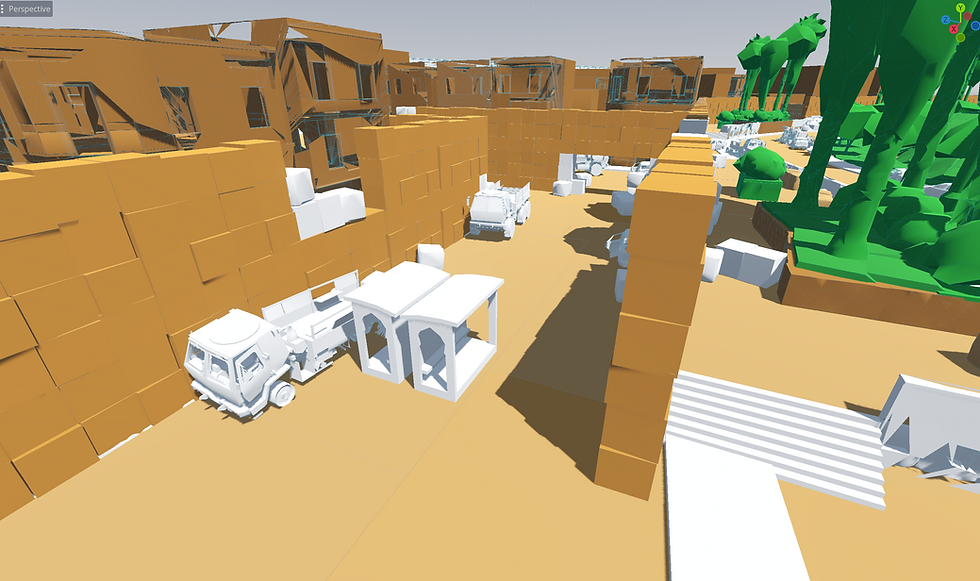
In the Portal Tools provided with the game, there is no terrain I can edit, forcing me to use big stone plates or bushes like this as the floor tiles.
Even doing small changes to the ground with this setup takes a long time. Combined with the small object limit of ~3500, the maximum object limit is quickly reached when trying to create a level that looks somewhat pretty.
Although these problems were annoying, they are nothing that breaks the game or my project. Adapting to them and working around them was possible but stole a lot of time in the development of this map.
» How do I make a real life location fit the game?
» What should the player experience / fantasy be in the level?
» What combat ranges or scenarios do I want?
» What gamemodes should this be designed for?
» What makes this space memorable?
» What distances / times do I want between flags and spawns?


iterations - Questions I wanted to answer throughout development